
What Is a Ludo Bonus? A Complete Beginner’s Guide
New to real-money Ludo apps? This guide explains everything in very simple words. No confusing terms. Just clear, step-by-step help for beginners.
Table of Contents
Getting Started
Introduction
If you have just opened a real-money Ludo app for the first time, you may have seen the word “bonus” somewhere on the screen. Maybe it was on the home page. Maybe it popped up right after you signed up.
You may have asked yourself: what does this bonus actually mean? Is it free money? Can I use it right away? Is there a catch?
This guide answers all of these questions in very simple words. You do not need any past experience to understand this article. We will explain everything step by step, from the basic meaning of a Ludo bonus to how the app screens usually work.
We will also talk about safety. Real-money gaming is not a toy. It involves real money, real risk, and rules that you should understand before you play. This guide will help you understand the basics so you can make informed choices.
You do not need to read this guide in one sitting. Feel free to use the Table of Contents above to jump straight to the part you need. Whether you just want to know what a bonus is, or you want to understand every screen in a typical app, this guide is built so you can find your answer quickly.
Please note: This article is written only to help beginners understand how Ludo bonuses and app features generally work. It does not promise that you will win or earn money. Real-money gaming always carries financial risk.
The Basics
What Is a Ludo Bonus?
Let’s start with the simplest explanation possible.
A Ludo bonus is extra credit given to you by a real-money Ludo app. This credit is added to your account. You did not pay for it directly. The app gives it to you, usually to welcome you, to reward you for adding money, or to thank you for inviting a friend.
At first, this sounds like free money. But it is important to understand one thing clearly: a bonus is usually not the same as cash in your bank account. It comes with rules. You often need to use it inside the app, in real games, before any part of it can become real, withdrawable money.
Think of it like a shopping voucher. A shop may give you a Rs. 100 voucher. You cannot take that voucher to the bank and turn it into cash. You can only use it to buy something in that shop. A Ludo bonus works in a similar way — you use it to play, not to withdraw directly.
Why This Matters for Beginners
Many beginners get confused here. They see a bonus amount added to their wallet and think it is the same as their own money. Then, when they try to withdraw it, they find out it is not allowed yet. This is not a trick — it is simply how bonuses are designed to work. Understanding this from day one will save you a lot of confusion later.
Another way to think about it: imagine a gym offers you one free trial class. You did not pay for that class, but you also cannot ask the gym to hand you cash instead of letting you attend. The value is in using it, not in cashing it out. A Ludo bonus works on a similar idea — its value comes from playing, and only under specific conditions does it turn into something you can actually take out of the app.
Behind the Scenes
Why Do Apps Give Bonuses?
It helps to understand why bonuses exist in the first place. Apps are businesses. Getting new users costs money — through advertising, offers, and marketing. A bonus is one way apps try to get people to try the app and keep coming back.
A welcome bonus makes it easier for a beginner to try their first game without feeling unsure. A deposit bonus encourages users to add more money to their wallet. A referral bonus turns existing users into a kind of word-of-mouth marketing team.
None of this makes bonuses bad. It simply means a bonus is a marketing tool, not a free gift with no strings attached. Knowing this helps you look at any bonus offer with a clear, calm mind, instead of excitement alone.
Bonus Formats
Types of Ludo Bonuses
Not every bonus works the same way. Here are the most common types you will come across as a beginner.
| Bonus Type | When You Get It | What It Usually Means |
|---|---|---|
| Welcome Bonus | Right after you sign up | A small amount to help you try your first game |
| Deposit Bonus | When you add money to your wallet | Extra credit, usually a percentage of your deposit |
| Referral Bonus | When a friend joins using your code | A reward for both you and your friend, once they meet certain conditions |
| Daily Login Bonus | When you open the app each day | A small, growing reward for coming back daily |
| Event Bonus | During special events or festivals | A time-limited offer tied to a specific event |
Some apps give only one or two of these. Others combine several at once. As a beginner, your job is simply to notice which type of bonus you are being offered, and then check its rules before using it.
It also helps to remember that bonus offers can change over time. An app might run a special deposit bonus this week and a different one next month. Because of this, it is always worth checking the current terms each time, rather than assuming they are the same as before.
The Fine Print
How a Bonus Actually Works
This is the most important section in this whole guide. Please read it slowly.
Almost every bonus comes with something called a wagering requirement. This is simply a rule that says how many times you must use the bonus in games before its winnings can be withdrawn.
Let’s use a simple example. Imagine an app gives you a Rs. 50 bonus with a “5x wagering requirement”. This means you need to play Rs. 250 worth of games using that bonus before any winnings from it become real, withdrawable money.
| Step | What Happens |
|---|---|
| 1. Bonus credited | Rs. 50 added to your bonus balance |
| 2. Wagering rule | 5x means Rs. 250 of play is needed |
| 3. You play games | You use the bonus balance to join games |
| 4. Requirement completed | Once Rs. 250 worth of play is done, the rule is met |
| 5. Winnings become usable | Any winnings earned can now possibly be withdrawn, based on other app rules like KYC |
Three Types of Balances
Most apps split your money into three separate parts. Understanding this is very helpful:
- Deposit Balance — the money you added yourself.
- Bonus Balance — promotional credit, not directly withdrawable.
- Winnings Balance — money earned from games, which can usually be withdrawn once rules like KYC are completed.
Remember: A bonus itself is usually not what you withdraw. It is the winnings you earn while using it that may eventually become withdrawable, and only after you meet all the app’s conditions.
This may feel like a lot of small rules for beginners to remember. A simple habit that helps is to always open the terms page linked to any bonus before tapping “claim”. Reading it once, even quickly, is usually enough to avoid confusion later.
Getting Familiar
How the App Interface Works
Now that you understand what a bonus is, let’s look at how a typical real-money gaming app is generally laid out. Every app looks a little different, but most follow a similar basic pattern.
When you open an app like this, you usually land on a home screen. This home screen normally shows your balance, some offers, and buttons to enter different games. From there, you can usually reach your wallet, your profile, and different game categories through a menu or bottom bar.
The goal of this section is simple: to help you recognise common screens so you don’t feel lost the first time you open an app.
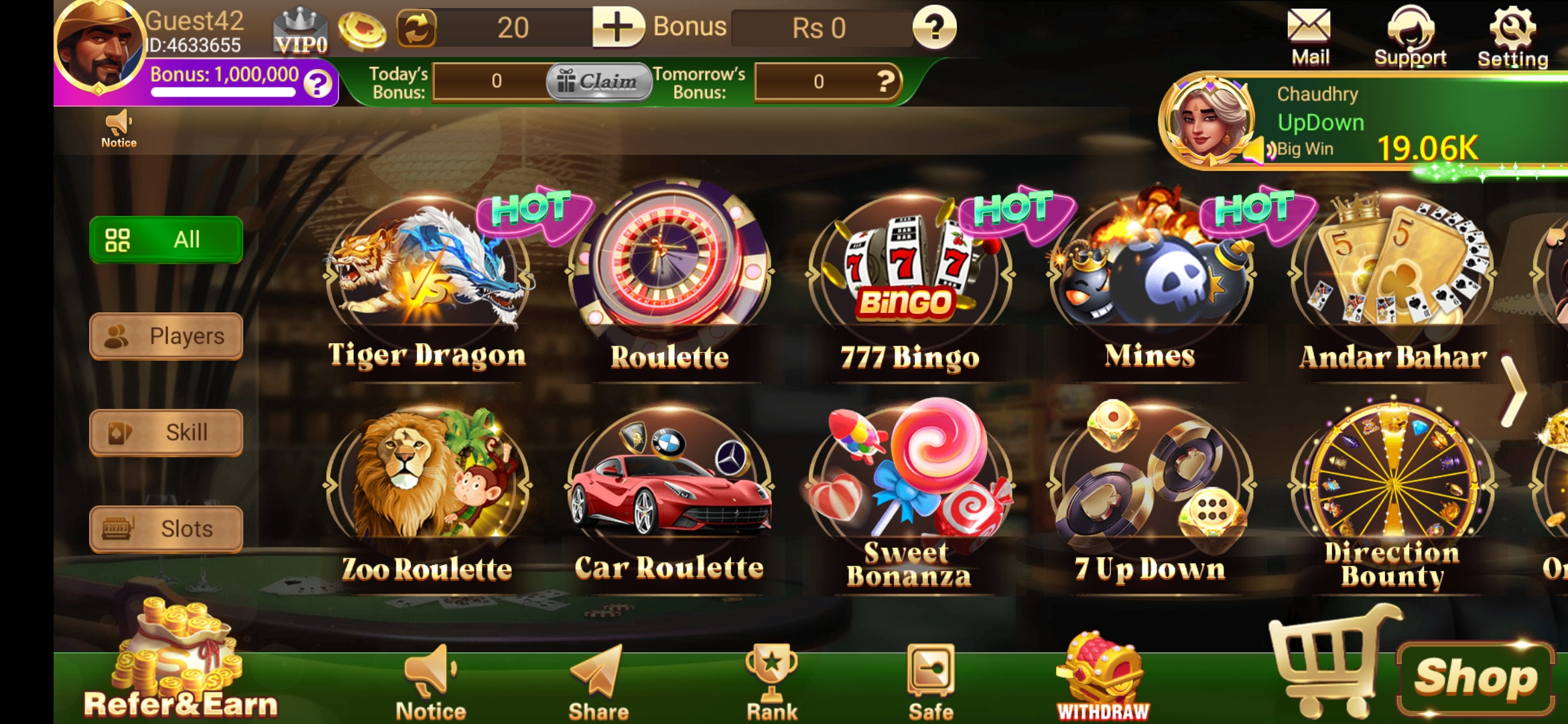
Home Screen Basics
Understanding the Main Dashboard
The main dashboard is simply the home screen you see when you open the app. Think of it as the front door of the app. From here, you can usually reach everything else.
Most dashboards include a few common parts:
Balance Display
Shows your total balance, often split into deposit, bonus, and winnings.
Offers Banner
Shows current bonus offers or events running in the app.
Game Shortcuts
Quick buttons that take you straight into popular games.
Profile & Menu
Leads to your account details, settings, and support options.
As a beginner, spend a few minutes just looking around the dashboard before you play anything. Tap on each section slowly. This helps you feel comfortable before real money is involved.
There is no rush. Apps are usually designed so you can look around freely without needing to spend money right away. Use this time to become familiar with where things are, so that once you do decide to play, you already know your way around.
Game Types
Game Categories Overview
Real-money gaming apps usually organise their games into categories, so players can find what they like more easily. Common categories include card games, table games, and simple casual games.
Below, we explain some common game types you may come across. These explanations are general. They describe how these game types usually work, not the exact version found in any one specific app. Always check the in-app rules page for the exact version you are playing.
Card Game
Dragon vs Tiger — Overview
Dragon vs Tiger is a simple card game. Two cards are placed on the table — one marked “Dragon” and one marked “Tiger”. Players simply guess which side will get the higher card. Sometimes there is also a “Tie” option, for when both cards are equal.
This game is popular with beginners because the rules are very short. There is no complicated strategy — just a simple guess. Because of this simplicity, rounds are usually quick.
Because outcomes depend mostly on chance, it is wise to treat this as entertainment, not a way to make steady income.
New players sometimes think that watching past results can help predict the next round. In games like this, each round is usually independent, meaning earlier results do not control what happens next. Keeping this in mind can help you enjoy the game without expecting patterns that may not really exist.
Table Game
Roulette — Overview
Roulette is a classic table game. A wheel with numbers spins, and a small ball is dropped onto it. Players guess where the ball will land — a specific number, a colour, or a group of numbers.
Digital roulette games in apps usually work the same way, just shown on your screen instead of a real wheel. Since the ball’s final position is random, no one can predict it with certainty.
Beginners often start with simple guesses, like picking a colour, since these usually have easier odds to understand than picking one exact number. Taking time to understand the betting options on the screen before joining a round can make the game much less confusing.
Table Game Variant
Zoo Roulette — Overview
Zoo Roulette is a playful version of roulette. Instead of only numbers, the wheel shows pictures of animals. Players pick an animal instead of a number, which can feel more fun and less confusing for new players.
Apart from the animal pictures, the basic idea is the same as regular roulette — a spin, a random result, and a simple guess beforehand.
This animal-themed style is often used to make the game feel friendlier for people trying table games for the very first time. But it is worth remembering that the underlying randomness is exactly the same as any other roulette game, just wrapped in a more colourful design.
Traditional Card Game
Andar Bahar — Overview
Andar Bahar is a well-known traditional Indian card game. One card is placed in the middle. Then cards are dealt one by one to two sides, called Andar (inside) and Bahar (outside). Players guess on which side a matching card will appear first.
This game is loved for being simple and fast. Since it has been played in India for generations using a normal deck of cards, many beginners already understand the basic idea, even if the app version looks new.
Because each round usually finishes quickly, it can feel easy to play many rounds back to back. This is exactly why setting a personal time or spending limit before you start is especially useful with fast-paced games like this one.
Number Game
Bingo — Overview
Bingo is a number-matching game. Players usually have a card filled with numbers. As numbers are called out or drawn, players mark the matching numbers on their card. The goal is usually to complete a specific pattern, like a full line or a full card.
Bingo is popular because it feels social and relaxed compared to fast card games. Many people grew up playing simple versions of Bingo at school or family events, which makes the digital version feel familiar.
Unlike some faster games, Bingo rounds often take a little longer to finish, since numbers are usually revealed gradually. This slower pace can make it a good starting point for beginners who want to understand a game without feeling rushed.
Grid Game
Mines — Overview
Mines is a simple grid-based game. You see a grid made of small tiles. Some tiles are “safe” and some are hidden “mines”. Players click tiles one at a time, hoping to avoid the mines.
The more safe tiles you reveal, the more the potential reward may grow — but the risk also grows, since a hidden mine could appear at any point. This mix of small decisions and rising risk is what makes Mines-style games popular, but it also means the risk increases the longer you continue.
Many players choose to stop after revealing just a few tiles, rather than continuing until a mine appears. Deciding on this kind of personal limit before you start playing can help you stay in control of the game, instead of the game controlling your decisions.
App Feature
Refer & Earn Section Explained
Most real-money gaming apps have a “Refer & Earn” section. This is where you get a personal code or link. When you share it with a friend, and they sign up using it, you may receive a reward. Sometimes your friend also gets a small welcome reward.
This feature is simple to use, but it is worth pausing on before sharing your code widely. Real-money gaming involves financial risk. When you invite a friend, you are inviting them into an activity that involves spending real money, not just a fun app. Only share your code with people who already want to try it themselves, and who understand what it involves.
It also helps to remember that a referral reward is usually credited only after your friend completes a specific action, such as signing up and playing their first paid game. Simply sharing a link does not guarantee a reward — the friend’s own activity usually decides that.
App Feature
Mail Section Explained
The Mail section works like an inbox. It is where the app sends you personal messages, such as updates on a bonus you claimed, a receipt for a transaction, or a note about an event you joined.
It is a good habit to check this section occasionally, especially after claiming any offer. It often has details you may need later, like exact bonus amounts or expiry dates.
Some beginners ignore this section completely and later forget important details about a bonus they claimed weeks earlier. Checking your Mail every so often can save you from this kind of confusion.
App Feature
Notice Section Explained
The Notice section is different from Mail. Instead of personal messages, it usually shows general announcements meant for all users — things like planned maintenance times, updated rules, or safety reminders.
Beginners sometimes skip this section, but it is worth a quick look now and then, especially if something in the app suddenly looks different or unavailable.
Notices can also explain temporary changes, such as a game being unavailable for a short time due to maintenance. Checking here first can save you from thinking something is broken when it is simply a planned, short-term update.
App Feature
Support Section Explained
The Support section is where you go if you have a problem or a question. This could be about a payment that didn’t go through, a bonus you don’t understand, or a technical issue with a game.
A good support section usually offers more than one way to get help, such as live chat, email, or a help-center with common questions already answered. Before trusting any app fully, it is worth checking that this section actually works and responds.
If you ever face an issue with a payment or a bonus, it helps to save screenshots of what happened before contacting support. This makes it easier to explain your problem clearly and get help faster.
App Feature
Shop Section Explained
Some apps include a Shop section. Here, you may be able to use points, coins, or credits you’ve earned to get small in-app items or extra perks. This is different from your main wallet, which deals with real money.
Think of the Shop as a rewards counter, separate from your actual cash balance. Always check what currency is being used before spending anything there.
Items in a Shop section are usually small extras, not something that affects your real winnings. Treat this section as a fun bonus feature, not a core part of how the app works.
App Feature
Ranking System Explained
Many apps use a ranking or level system, often shown with names like Bronze, Silver, or Gold. Your rank usually goes up as you stay active in the app over time.
Higher ranks sometimes unlock small extra perks, like slightly better daily rewards or early access to events. However, rank is mainly a way for apps to keep users engaged. It is not a requirement for enjoying the basic features of an app, and chasing a higher rank should never come before your own budget and comfort.
App Feature
Daily Rewards Explained
Daily rewards are small bonuses given simply for opening the app each day. Many apps use a “streak” system, where the reward slightly increases the longer you keep logging in without missing a day.
These rewards are usually small and are meant to build a habit of opening the app regularly. As a beginner, it helps to remember that a daily reward is a small marketing tool, not a reason to feel obligated to play every single day.
App Feature
Events Explained
Events are special activities that run for a limited time, often linked to a festival, weekend, or app anniversary. They may include special game modes, extra rewards, or themed challenges.
Like most other features, events are designed to bring extra excitement and activity to the app. They do not guarantee any reward. Always read an event’s terms before joining, so you understand exactly what is required and what, if anything, you might receive.
Helpful Advice
Beginner Tips
Read before you tap “Claim”
Always check a bonus’s wagering rule and expiry date before accepting it.
Explore the app slowly
Spend time understanding the dashboard, wallet, and menus before playing with real money.
Set a budget first
Decide how much you are comfortable spending before you start, and stick to that amount.
Complete KYC early
Verifying your identity ahead of time avoids delays later when you want to withdraw.
Keep track of your balances
Check your wallet regularly so you always know what is deposit, bonus, or winnings.
Take breaks often
Step away regularly instead of playing for long, continuous periods.
What to Avoid
Common Mistakes Beginners Make
Many beginner problems come from a small number of repeated mistakes. Here are the most common ones. Recognising them ahead of time is one of the easiest ways to avoid feeling frustrated or confused later.
Skipping the Terms
Claiming a bonus without reading its wagering rule or expiry date.
Spending More to “Finish” a Bonus
Adding extra money just to complete a wagering requirement faster.
Letting Bonuses Expire
Forgetting the deadline and losing unused bonus credit.
Sharing Referral Codes Too Widely
Inviting people who may not understand or want the financial risk involved.
Playing Safely
Safety Tips
- Check local rules: Confirm that real-money gaming is allowed where you live before creating an account.
- Look for clear terms: Choose apps that explain their bonus rules in plain language.
- Protect your login details: Never share your password or OTP with anyone.
- Use official app stores: Download apps from trusted sources whenever possible.
- Keep records: Save screenshots of important transactions and bonus terms.
Simple rule: If something feels confusing or too good to be true, slow down and read the terms again before doing anything else.
Please Read
Responsible Gaming
Real-money gaming should always stay fun and within your control. Here are simple habits that help:
- Set a spending limit before you start, and do not go beyond it.
- Never treat gaming as a way to earn a steady income.
- Take regular breaks and avoid long, non-stop sessions.
- Never chase losses by spending more money to “win it back”.
- Real-money gaming is only for adults aged 18 and above.
It is completely normal to decide, at any point, that you simply do not want to continue playing. You do not need a specific reason. Walking away is always allowed, and it is often the safest choice when something no longer feels enjoyable.
Know the Rules
Is Real-Money Ludo Legal?
This is one of the most important questions a beginner can ask, and the honest answer is: it depends on where you live.
In India, laws about real-money gaming are decided at the state level, not just at the national level. Courts have often looked at whether a game depends mostly on skill or mostly on chance. Games seen as needing more skill are usually treated differently from pure gambling. Ludo, because it mixes dice luck with player choices, has been discussed under this kind of test in different cases over the years.
Some states allow real-money skill games with few restrictions. Other states have placed strict limits or bans on this kind of activity. Because of this, the same app may work normally in one state and be blocked in another.
This section is general information, not legal advice. Laws can change over time. Always check the current rules in your own state before creating an account or spending any money.
Making Good Choices
How to Choose a Safer App
Not all apps are the same. As a beginner, here are simple things to check before trusting any app with your money.
Clear Terms
Bonus rules, wagering requirements, and expiry dates should be written in plain, easy language.
Working Support
A real support team that actually replies, not just a form that goes nowhere.
Safety Tools
Options like deposit limits, cool-off periods, or self-exclusion show the app cares about player wellbeing.
Genuine Reviews
Look for real user feedback about withdrawals and support, not just advertising claims.
Taking a few extra minutes to check these details before signing up is one of the simplest ways a beginner can avoid problems later.
Simple Definitions
Easy Glossary of Common Words
Here are simple meanings for words you will often see in real-money gaming apps.
| Word | Simple Meaning |
|---|---|
| Wagering Requirement | How many times you must play a bonus before its winnings can be withdrawn |
| KYC | A simple identity check using your ID, done before withdrawals |
| Wallet | The place inside the app where your money and credits are stored |
| Deposit | Money you add into the app yourself |
| Withdrawal | Taking money out of the app to your bank account |
| Entry Fee | The amount you pay to join a paid game |
| Prize Pool | The total reward shared among winners of a game |
| Expiry Date | The last date a bonus can still be used |
Quick Answers
Frequently Asked Questions
What is a Ludo bonus?
A Ludo bonus is extra credit that a real-money Ludo app gives you. You can use this credit to join games. It is not the same as cash you can withdraw right away.
Is a Ludo bonus real money?
Not exactly. A bonus is credit inside the app. It usually turns into real money only after you meet certain conditions, like playing a set number of games.
Can I withdraw my Ludo bonus directly?
In most cases, no. You first need to use the bonus in games. Only the winnings you earn from it may become withdrawable, and only after you meet the app’s rules.
What does ‘wagering requirement’ mean?
It means the number of times you must use a bonus amount in games before its winnings can be withdrawn. For example, a 5x requirement on a Rs. 50 bonus means Rs. 250 worth of play is needed first.
Why do apps give bonuses?
Apps give bonuses to attract new users and to keep existing users playing. It helps them grow, just like a shop gives a discount coupon to attract customers.
Do all Ludo apps give the same bonus?
No. Every app has its own bonus type, amount, and rules. Always read the terms before you use any bonus.
What is a welcome bonus?
A welcome bonus is a small bonus given to new users right after they create an account. It is meant to help beginners try the app.
What is a deposit bonus?
A deposit bonus is extra credit added when you put money into your wallet. It is usually a percentage of the amount you deposit.
What is a referral bonus?
A referral bonus is credit you get when you invite a friend and they join the app. Some apps also give a bonus to the friend you invited.
What is a daily login bonus?
This is a small reward you get for opening the app and logging in every day. Many apps increase the reward if you keep a daily streak.
Do bonuses expire?
Yes, most bonuses have an expiry date. If you don’t use the bonus before it expires, it is usually removed from your account.
What happens if I don’t complete the wagering requirement?
If you don’t complete it before the bonus expires, you may lose the unused bonus amount. This is why reading the terms is important.
Is KYC required to withdraw money?
Yes. Most real-money apps ask you to verify your identity (called KYC) before you can withdraw any money, including bonus-related winnings.
What is KYC?
KYC means ‘Know Your Customer’. It is a simple identity check using documents like your ID card, done to keep the app safe and fair.
What is a wallet in a gaming app?
A wallet is where your money and credits are stored inside the app. It usually shows separate balances for deposit money, bonus credit, and winnings.
Why are there separate balances in the wallet?
Apps keep deposit money, bonus credit, and winnings separate because each one has different rules for using and withdrawing.
What is the main dashboard?
The main dashboard is the home screen of the app. It usually shows your balance, offers, and quick links to games.
What are game categories?
Game categories are groups of similar games. For example, card games, table games, and casual games are usually placed in separate categories.
What is Dragon vs Tiger?
Dragon vs Tiger is a simple card game. Two cards are shown, one for Dragon and one for Tiger, and players guess which side will have the higher card.
What is Roulette?
Roulette is a game where a wheel spins and a ball lands on a number or color. Players try to guess where it will land before the wheel stops.
What is Zoo Roulette?
Zoo Roulette is a fun version of roulette that uses animal pictures instead of only numbers, making it easier for beginners to follow.
What is Andar Bahar?
Andar Bahar is a traditional Indian card game. A card is placed in the middle, and players guess if a matching card will appear on the Andar (inside) or Bahar (outside) side.
What is Bingo in gaming apps?
Bingo is a number-matching game. Numbers are called out or drawn, and players mark matching numbers on their card to try to complete a pattern.
What is Mines?
Mines is a simple grid game. Players pick tiles on a grid, hoping to avoid hidden ‘mines’, while trying to reveal safe tiles.
Are these games based on luck or skill?
Most of these games mix luck and simple decision-making. Understanding the basic rules helps, but outcomes are still uncertain.
What is the Refer & Earn section?
This is a section where you get a code to share with friends. If your friend joins using your code, you may receive a reward, based on the app’s terms.
Is it safe to refer friends?
Only refer friends who genuinely want to try the app and understand it involves real money. Never pressure anyone to join.
What is the Mail section in an app?
The Mail section is like an inbox. It shows messages from the app, such as bonus updates, event announcements, or account information.
What is the Notice section?
The Notice section shows important announcements from the app, like maintenance updates, new rules, or safety information.
What is the Support section?
The Support section helps you contact the app’s customer care team if you have questions or face any problem.
What is the Shop section?
The Shop section is where you may be able to use points or credits to get in-app items or small rewards, depending on the app.
What is a ranking system?
A ranking system sorts players into levels or tiers based on their activity in the app. Higher ranks sometimes unlock extra features.
Do I need a high rank to play?
No. Ranking is optional and mainly for engagement. You can enjoy the basic features of the app without focusing on rank.
What are daily rewards?
Daily rewards are small bonuses or credits given simply for opening the app each day. They usually reset if you miss a day.
What are events in gaming apps?
Events are special, time-limited activities or offers that apps run during festivals, weekends, or specific periods.
Do events guarantee a reward?
No. Events usually give you a chance to earn something extra, but nothing is guaranteed. Always read the event terms first.
What is the safest way to start as a beginner?
Start by reading the app’s terms, understanding the wallet sections, setting a budget, and never spending more than you planned.
What is a common mistake beginners make?
A common mistake is claiming a bonus without reading its terms, then feeling confused later about why money can’t be withdrawn.
Should I chase losses to complete a bonus?
No. Never add more money just to finish a bonus’s wagering requirement. This can lead to spending more than planned.
Is real-money Ludo legal everywhere in India?
No. Laws are different in each state. Some states allow skill-based real-money games, while others restrict them. Always check your local rules.
What age do I need to be to use these apps?
You must usually be at least 18 years old to create an account and use any real-money gaming app.
What should I do if gaming stops feeling fun?
Take a break, use any self-exclusion tools inside the app, and talk to someone you trust. You can also contact a local support helpline.
Can bonuses guarantee that I will earn money?
No. Bonuses are promotional tools, not a guarantee of earnings. Real-money gaming always involves risk, and outcomes are uncertain.
Important
Disclaimer
This article is for general educational purposes only. It explains common features found in many real-money gaming apps in simple language, but it does not describe any single app exactly, and it does not endorse any specific platform. This is not financial or legal advice. Real-money gaming involves financial risk, is meant only for adults aged 18 and above, and may be restricted or prohibited in some states or regions. Bonuses mentioned in this article are not guaranteed earnings. Please check your local laws and the specific terms of any app before creating an account or using real money.
Pingback: Ludo Bonus Login Guide 2026 | Sign In, Account Access & Login Help